Ready to lower your CAC?
Marketing jargon can be confusing. Mailchimp isn’t. Convert more leads and grow your business.
Marketing your business isn’t cheap. According to the United States Small Business Administration, B2C (business to consumer) product companies spend about 9.6% of their revenue on marketing, while B2B (business to business) service companies spend 11.8%. In other words, if your B2C company brings in $300,000 a year, around $28,800 should go into marketing. But how do you ensure that’s money well spent? One important metric to look at is customer acquisition cost (CAC).
This article will dive into what CAC is, how to calculate it, how to use it in your marketing, and how it relates to customer lifetime value.
What is CAC?
CAC, meaning customer acquisition cost, known in marketing circles as CAC, describes how much a company has to spend to get a new customer. The use of CAC marketing has risen in popularity as organizations use web analytics to make data-driven decisions. Whether they’re paying to have potential customers click on banners or investing in articles and graphic content, measuring their CAC helps companies figure out if they’re getting their money’s worth as they invest in growing their clientele.
Internet marketing methods can target specific groups of customers on a granular level. This is relatively new. Traditionally, companies had to cast a wide net with advertising, which involved aiming their marketing content at a broad segment of potential customers. The hope was that this would bring in at least some new customers. Because this approach lacks specificity, it was common for companies to see undersized returns on their marketing investments.
However, modern, targeted campaigns combined with CAC metrics can not only home in on specific groups of people but they can also tell you how much you’re spending per each new prospect to bring them on board and convert them to paying customers.
Why does CAC matter?
CAC reflects the success of your marketing and sales campaign performance. Your marketing and sales teams spend a lot of time, effort, and resources trying to find new customers and improve customer retention. Customer acquisition cost is just one important key performance metric your business must track to determine how effective your campaigns are.
Once you understand how much it costs to acquire a customer, you can begin strategizing to reduce those costs, ultimately boosting your return on investment (ROI.) For example, if you want to write a sales email that converts, you may measure the effectiveness of your campaign and A/B test different factors to identify ways to reduce that cost.
It costs less to retain customers than it does to find new ones. So, while CAC is an important metric, you must take into account other factors that may contribute to your bottom line, like customer retention.
How is customer acquisition cost calculated?
In short, to calculate CAC, you add up the costs associated with acquiring new customers (the amount you’ve spent on marketing and sales) and then divide that amount by the number of customers you acquired. This is typically figured for a specific time range, such as a year or a fiscal quarter.
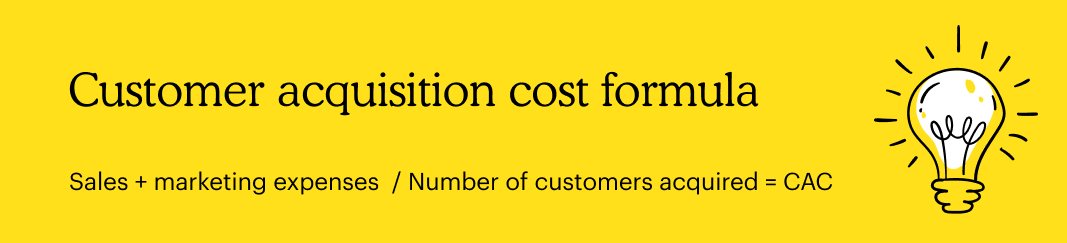
If an organization spent $1,000 on marketing in a year, and it was able to acquire 1,000 new customers, the CAC would be $1 because $1,000 divided by 1,000 customers equals $1 per customer.
On the other hand, if the company brought in 500 customers, their CAC would be twice as high, or $2, because they spent the same amount of money and brought in half the number of new customers.
This customer acquisition cost formula is pretty simple, but adding up total expenditures can take a lot of factors into account, including the cost of multiple marketing strategies and staff salaries.
Customer acquisition cost example
A fictitious furniture maker, Natural Seats, uses sustainable resources to build custom furniture. Natural Seats’ marketing efforts consist of:
- Paid sales and marketing staff
- Social media campaigns
- Pay-per-click advertising
- Quarter-page magazine ads in a journal read by its target market
The company decides to track how much it costs to acquire new customers for the period beginning January 1 and ending the following December 31 because this matches the start and end of their fiscal year. Natural Seats’ process is simple: They consider what they spend overall and how many new customers they have by December 31.
The expense sheet they’d use to calculate their CAC might look something like this:
| Marketing Tool | Cost Per | Quantity | Amount Spent |
|---|---|---|---|
| Sales and Marketing Staff | $50,000 | 3 | $150,000 |
| Social Media Campaigns | $1,000 | 12 | $12,000 |
| Pay-per-click advertising | $0.50 | 20,000 | $10,000 |
| Magazine Ads | $700 | 12 | $8,400 |
| Total Marketing Expenses: | $180,400 | ||
| New Customers Acquired: | 2,512 | ||
| CAC: | $71.82 |
According to Natural Seats’ calculations, they spent an average of $71.82 per new customer acquired during the fiscal year.
While this may be outrageously high for many companies, this is a pretty good number for Natural Seats. Custom furniture comes at a cost, and clients expect to pay a premium for sustainable products. Natural Seats’ least expensive item, a custom dining chair, costs $250. So even if each customer only purchased one item and it was Natural Seats’ least expensive offering, they would still realize a decent gross profit of $178.18 after their CAC.
However, this is only the beginning of the CAC story—you also have to consider how much each customer spends, which is calculated using customer lifetime value.
How customer lifetime value affects customer acquisition cost
Customer lifetime value (CLV, or sometimes LTV) is the amount your company makes from each customer during the customer’s “lifetime” of making purchases from you.
Of course, the amount of time a person remains a customer and how much they spend varies greatly among businesses and sectors, so you have to consider the factors that impact your company specifically. However, some elements of CLV are pertinent to most organizations.
- Average customer life span: This is how long the individual remains a customer.
- Rate of customer retention: The percentage of customers who buy again.
- Profit margin per customer: Expressed as a percentage, this may take into account CAC as well as other expenditures such as the overall cost of goods sold, which includes production and marketing costs, and how much it costs to run the company. To calculate the profit margin per customer, take your net income per customer, which is what each customer spends minus the CAC, then divide that number by your revenue from the customer over their lifetime with you. Multiply by 100 to get the percentage.
- Average amount each person spends over their lifetime as a customer: This is a simple calculation: Add up what each customer spends over their lifetime and divide it by the number of customers.
- Average gross margin per customer: This can be calculated for a finite time period, such as a year, or according to the customer’s life span. In the case of a life span calculation, take the profit margin per customer over their lifetime, divide it by 100, and multiply that by how much they spend during their lifetime.
Example of CLV: Networking equipment provider
Whole Networks is a fictitious company that provides networking equipment like routers, switches, access points, and servers by reselling original equipment manufacturer (OEM) items by major producers like Cisco and Fortinet. Whole Networks’ numbers stack up like this:
- CAC is $180 per customer.
- The average customer stays with Whole Networks for 10 years.
- Their profit margin per customer is 19%.
- The average amount spent by each customer over their lifetime with Whole Networks is $57,052.
- The average gross margin per customer over their lifetime with Whole Networks would be 0.19 x $57,052 = $10,840. This is the CLV of a Whole Networks customer.
Factoring in CLV when considering CAC
At first glance, Whole Networks’ CAC of $180 per customer may seem high, even for the technology sector. If they acquired 2,500 customers in a year, the expenditure would total $450,000, a rather steep figure. However, each customer is going to spend $10,840, so Whole Networks earns $10,660 per new customer, which is 60 times what it spends on acquiring each one. From this perspective, their CAC is relatively low.
Whole Networks’ return on investment (ROI) based on CAC:
| Customer Metric | Amount |
|---|---|
| CAC | $180 |
| Average customer life span | 10 years |
| Profit margin per customer | 19% |
| Average amount spent over lifetime with company | $57,052 |
| Average lifetime gross margin per customer | $10,840 |
| ROI per customer (gross lifetime margin − CAC) | $10,660 |
Factors affecting customer acquisition cost
When calculating CAC, it’s important to consider the business context in which the numbers are gleaned. For example, if you’re just breaking into a new market, your CAC may be higher because it often takes a greater up-front investment to get your marketing rolling in a new area.
Also, newer companies that have to hire marketing staff or existing companies that decide to augment their current marketing efforts with new people or technologies may have significantly higher CACs.
To illustrate, suppose a boutique sneaker company, YourKicks, has already established a market in New York City. To obtain its position in the boutique sneaker segment of metropolitan New York, it used social media, pay-per-click advertising, and several strategic partnerships with retailers who would sell their sneakers. At this point, with their marketing up and running in New York City, their CAC is $10 per new customer.
When YourKicks decides to target the Los Angeles market, some of their marketing efforts will require very little extra investment, while others will demand significant cash. For instance, the pay-per-click costs may be similar in Los Angeles and New York City, so that item in the CAC calculation may not change much. However, a Los Angeles-specific social media campaign will take significant time and human capital as they ramp it up. Also, acquiring new retail partners may involve heavy up-front investments in travel, meals, and other costs associated with landing each account. Therefore, the CAC for Los Angeles will be higher than what they are currently paying in New York City.
When factored into the overall costs of operation, the Los Angeles CAC may significantly impact the total CAC. But because this investment is necessary, it would be wrong to assume the Los Angeles market “costs too much,” at least until the number of new customers and sales revenues become comparable to New York’s.
How can you improve your customer acquisition cost?
To lower your CAC, you should work on converting leads and prospects to paying customers, upping the value of what customers get, and using a customer relationship management (CRM) platform to stay engaged with your audience.
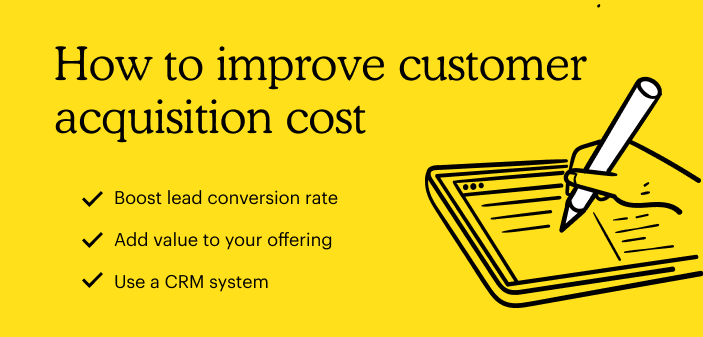
- Boost lead conversion rate: You can use Google Analytics to see things like how often customers abandon their shopping carts after adding an item. You can take a close look at how fast your webpages load and think about ways to make your landing pages more engaging if your website visitors are leaving without clicking through to other pages. You should also check how your site looks on mobile devices and how smoothly the checkout process works for buyers. Making all these experiences better for the customer will lead to more conversions.
- Add value to your offering: The value users perceive from your products and services is subjective, so adding features similar companies have implemented may not have the desired effect. Your customer retention strategy depends on your ability to determine what gets your customers excited about buying your products. This is best done by highlighting the importance of customer service throughout your organization. You can also spend time interacting with customers—using surveys or emails—to figure out what would best fit their needs. You can even study statistics such as your customer retention rates and more subjective feedback from the customer reviews you get. If you notice correlations, improving one may boost the other.
- Use a CRM system: A CRM platform can help you keep track of new customers, their movements through the marketing funnel, and how much they buy, including when and where, loyalty programs, and more. You can also use it to manage email lists and campaigns such as promotions, seasonal email advertising, and drip campaigns, which periodically send emails containing compelling content.
How can you benchmark customer acquisition cost?
To benchmark your CAC, you’ll want to boil your measurables down to simple, easy-to-interpret metrics.
- You need to bring in more money than you are spending on your CAC. While this may seem like it goes without saying, it gets more complicated as you factor in things like CLV and customer profit margins. A “low” monetization in the short term may look better over the long term.
- Try to recover your CAC in less than a year. Ideally, you want to earn at least as much as your acquisition cost from each customer by the time a calendar year passes.
- With social media marketing, track the number of shares. People only share content they value. If the content you’re paying for is bringing in customers and is being shared more than content you’ve previously produced, it’s doing its job.
- Use gated content and track how long it generates leads. Gate content is content a customer can only access by giving you their email address or other contact information. Strong gated content can bring in leads for several months or more. Compare that with subsequent content to gauge the effectiveness of your investment.
What customer acquisition cost can do for you
CAC, when combined with CLV, is a powerful tool in assessing your ROI and marketing goals. In the short term, you get a quantifiable assessment of what each customer costs, and in the long term, you gain a view of how much you make from each conversion. Mailchimp, you can use compelling marketing campaigns, well-designed websites, and audience engagement tools to convert more customers and lower your CAC.